 Add to Chrome
 Add to Firefox
 Add to Edge
RegFormer: Transferable Relational Grounding for Efficient Weakly-Supervised Human-Object Interaction Detection
Apr 01, 2026
Weakly-supervised Human-Object Interaction (HOI) detection is essential for scalable scene understanding, as it learns interactions from only image-level annotations. Due to the lack of localization signals, prior works typically rely on an external object detector to generate candidate pairs and then infer their interactions through pairwise reasoning. However, this framework often struggles to scale due to the substantial computational cost incurred by enumerating numerous instance pairs. In addition, it suffers from false positives arising from non-interactive combinations, which hinder accurate instance-level HOI reasoning. To address these issues, we introduce Relational Grounding Transformer (RegFormer), a versatile interaction recognition module for efficient and accurate HOI reasoning. Under image-level supervision, RegFormer leverages spatially grounded signals as guidance for the reasoning process and promotes locality-aware interaction learning. By learning localized interaction cues, our module distinguishes humans, objects, and their interactions, enabling direct transfer from image-level interaction reasoning to precise and efficient instance-level reasoning without additional training. Our extensive experiments and analyses demonstrate that RegFormer effectively learns spatial cues for instance-level interaction reasoning, operates with high efficiency, and even achieves performance comparable to fully supervised models. Our code is available at https://github.com/mlvlab/RegFormer.

Super-class guided Transformer for Zero-Shot Attribute Classification
Jan 16, 2025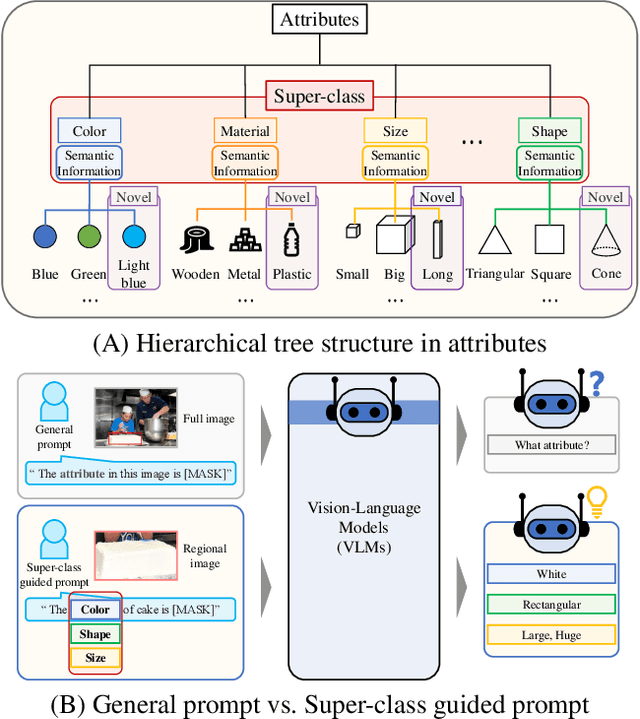
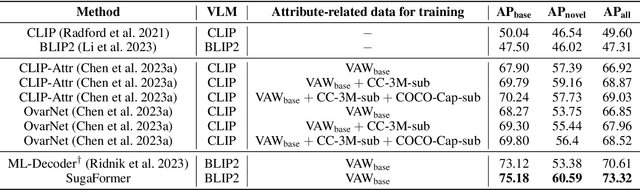
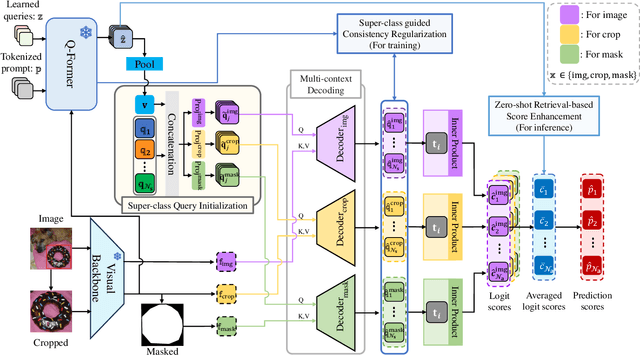
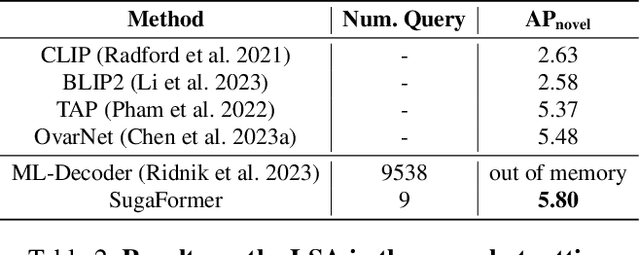
Attribute classification is crucial for identifying specific characteristics within image regions. Vision-Language Models (VLMs) have been effective in zero-shot tasks by leveraging their general knowledge from large-scale datasets. Recent studies demonstrate that transformer-based models with class-wise queries can effectively address zero-shot multi-label classification. However, poor utilization of the relationship between seen and unseen attributes makes the model lack generalizability. Additionally, attribute classification generally involves many attributes, making maintaining the model's scalability difficult. To address these issues, we propose Super-class guided transFormer (SugaFormer), a novel framework that leverages super-classes to enhance scalability and generalizability for zero-shot attribute classification. SugaFormer employs Super-class Query Initialization (SQI) to reduce the number of queries, utilizing common semantic information from super-classes, and incorporates Multi-context Decoding (MD) to handle diverse visual cues. To strengthen generalizability, we introduce two knowledge transfer strategies that utilize VLMs. During training, Super-class guided Consistency Regularization (SCR) aligns model's features with VLMs using super-class guided prompts, and during inference, Zero-shot Retrieval-based Score Enhancement (ZRSE) refines predictions for unseen attributes. Extensive experiments demonstrate that SugaFormer achieves state-of-the-art performance across three widely-used attribute classification benchmarks under zero-shot, and cross-dataset transfer settings. Our code is available at https://github.com/mlvlab/SugaFormer.